
“The munificence of Miss Johnson has extended the boon of pure water to the poor …. To her there must be a great inward satisfaction of doing good. We are sure this is supported by the deep gratitude of the poor – a gratitude that will grow and expand as the years fly past. In our minds it but crowns the edifice of a long list of noble gifts and deeds that will not soon be forgotten …”
Lincolnshire Free Press, 30 December 1873.
Signifance
The Past
Squalor & Misery
The average life expectancy in Spalding in 1850 was 23 years and 9 months. Roughly a third of children died before reaching 5 years old. This is not perhaps surprising, as most people were dependent on well-water, which was more or less contaminated as there was no sewerage system. (The well-to-do could buy spring water by the pail brought in from Bourne in water- carts.) There were six slaughter-houses near the town centre, none of which had proper drainage, with the waste thrown into cess pools or boiled for pig-food. Cess-pits were often no more than open ditches and in the worst quarters of the town human excrement was piled up in the centre of the cramped courtyards. A government health inspector reported seeing “more squalor and misery [than] could scarcely be surpassed in the crowded lanes and allies [sic] of the Metropolis itself”.
The local authority showed no concern to improve either water supply or sewage disposal, preferring to use the improvement rate to put gaslights in the streets, build a corn exchange and buy land for a cemetery, and it was left to the newly-formed Spalding Water Works Company (1860) to set up a private water works, with filtering beds and a brick water tower. This was in Pinchbeck Road (where the open-air swimming pool was later built), with the water piped along Pinchbeck Road to a limited area of the town centre. At first water was drawn from the Blue Gowt Drain, but this proved unreliable in times of drought, so in 1870 an Act of Parliament was obtained and capital raised to pipe spring water from Bourne to the Spalding Water Works.
Miss Mary Ann Johnson
It was, however, solely due to an act of personal generosity that this supply of good-quality water was extended to the poorer parts of the town. In 1873 Miss Mary Ann Johnson gave the Spalding Water Works Company £1,500 – that is, £150,000 in today’s money – to lay water mains along Winsover Road as far as the ‘Robin Hood’ and then up Hawthorn Bank; along Holbeach Road to the ‘Pigeon Inn’; and along London Road to Little London. To mark their gratitude to Miss Johnson the Company decided to erect a commemorative public drinking fountain in the town centre.
The Fountain
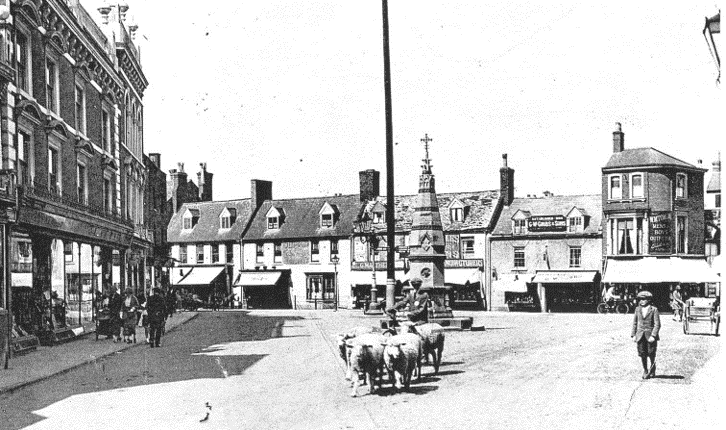
The fountain was designed to go “in the Market Place”. Hence its impressive size. Work had begun on the mains in November 1873, and by July construction of the fountain was under way – now in Hall Place – on the site of an old pump. By the beginning of August it was complete.
Removal from Hall Place
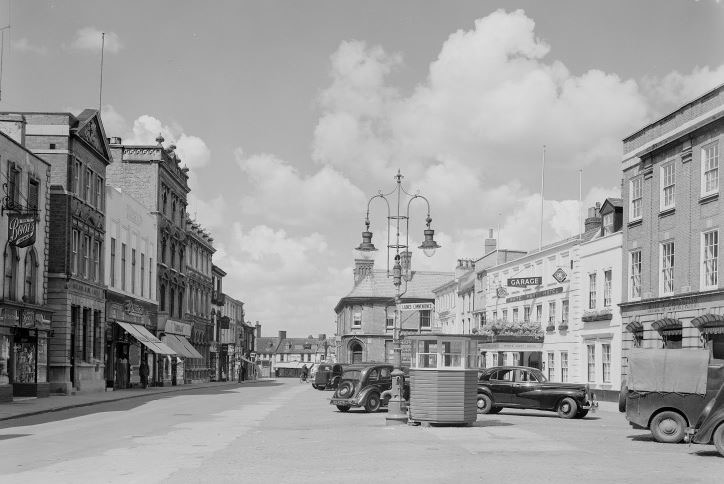
The dismantling in 1954 was controversial. “One of the biggest crimes that has happened in Spalding,” said one councillor. Basically a group of councillors wanted the fountain out of the way because it was interfering with the County Surveyor’s experimental traffic measures in Hall Place. None of them had given any thought to its re-siting – or indeed whether to re-erect it at all. The Council approved the dismantling by the narrow margin of 7-5 on the Wednesday evening, and by teatime the following day it was gone. “If other things were done as quickly it would be nice,” commented one member of the public. There was no coherent overall plan. It was not until two years later that it was decided to put the fountain together again, in Ayscoughfee Gardens.
Moved again
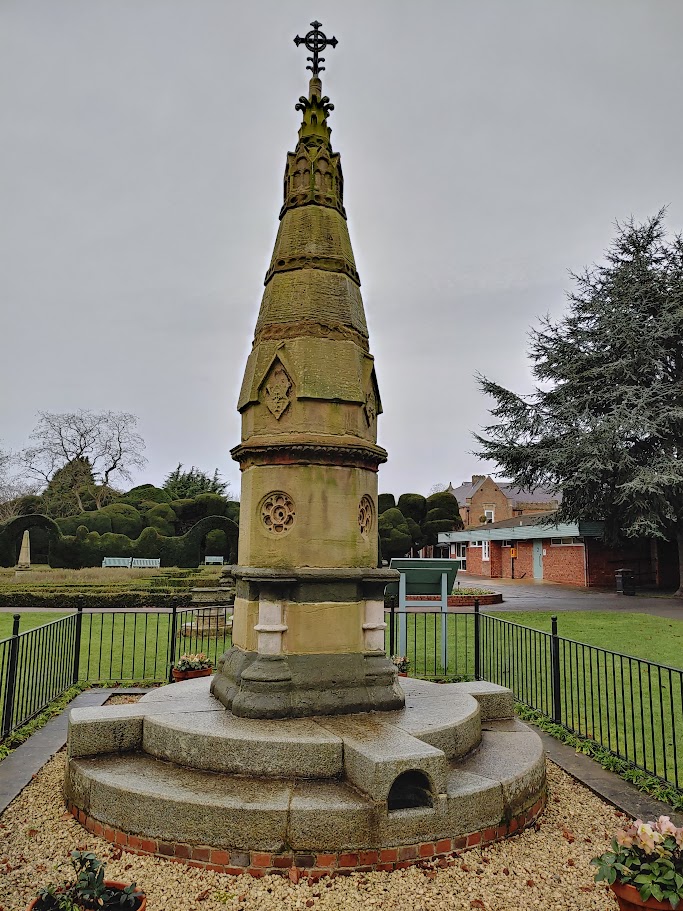
In 2018, again the fountain was dismantled, this time to make way for the WW2 Memorial. Its pieces were put into temporarily in storage at the Council’s works depot; but at the South Holland District Council’s annual meeting the Council Chairman, Councillor Rodney Grocock, pledged that the fountain would eventually be re- erected in the town centre. We very much welcomed this announcement, as we have long wanted to see it returned to the town centre.
However, our hopes were dashed, despite a campaign supported by many in the town including a petition signed by over 400 people calling for it to be returned to the town centre. The promise made was broken and it is now back in a different location in Ayscoughfee Gardens acting as a grand garden ornament.
It remains our ambition to see it returned to the town centre as a functioning public drinking fountain.
Our campaign for the return of the Fountain to the Town Centre
Why it is special
Why it should be in the Town Centre
- The fountain was always intended for the centre. “In the Market Place”, say the minutes of the Spalding Waterworks Company. Hence the gothic grandeur of its design.
- It needs a busy place. As a memorial, the more people that see it the better it does its job – commemorating Miss Johnson’s generous gift of clean water for “the labouring classes”, “the poor”. Ordinary people. Positioned in Ayscoughfee Gardens the memorial purpose is stymied, as relatively few people visit the gardens compared with the many in the town centre each day. It would be a true act of remembrance, therefore, to re-erect the fountain amidst ordinary people going about their ordinary lives, rather than in a former pleasure ground of the gentry.
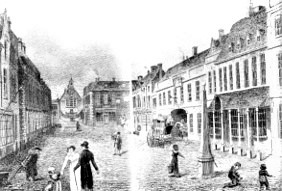
- Put in the Market Place, it would reconnect us to our history by restoring a focal point. Older OS maps note the site of a former market cross there, and the Hilkiah Burgess engraving (1822) shows a quite impressive public water pump. (Was the spire like pump the inspiration for the fountain’s shape?)
- It would strengthen Spalding’s identity. An important part of that identity was lost when the fountain was replaced by the stock paraphernalia of a traffic roundabout. Restored to the centre, it would make the centre something special again, clearly distinct from Bourne or Boston, Sleaford or Stamford. Far from being just another ornamental object in a park, if it was re- erected in the Sheepmarket or Hall Place or the Market Place its striking prominence would transform the public space around it.
- A bold step like this would be proof that there really was a will to make a difference – as part of a long-needed regeneration of the centre, reviving its vitality and viability. Tourists visit historic towns that are different, delightful, interesting, with a strong visual character of their own. And if the centre is to tap into Springfields 2.4m annual visitors,one key way is to enhance the centre, to make it as attractive as possible to live and work in and to visit. Not to mention retaining resident shoppers. Increased attractiveness means increased footfall. These are the underlying aims of the Society’s MARK-IT project, too.
- And such a return could even make national news – if it ran water again. In a letter to the Free Press in January 2018 Mark Loosemoore wrote: “Given the current concern over plastic pollution caused in no small extent by single use drinking bottles surely this is the ideal opportunity to be proactive”, even to “get ahead of the game”, by providing “a constant supply of free drinking water available to all in the centre of town” (30 January 2018).
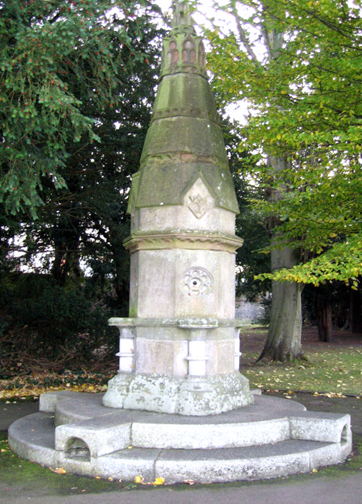
- Drinking fountains are fashionable again with old ones being restored to working order in London and elsewhere alongside new ones as part of actions to tackle plastic pollution. Heritage of London Trust have restored 18 to date and are working on 6 more. For example the following in Hounslow.