
Joseph Hillier was commissioned by Transported and Spalding & District Civic Society in 2016 to create a series of sculptures portraying the people who together reflect the unique character of Spalding and it’s importance to the nation’s food supply.
The project was part of Transported’s On Your Doorstep programme – public realm enhancement projects where artists, designers and sculptors are commissioned by local groups, residents and organisations to improve public spaces, making them more interesting, attractive and cared for.
After Spalding town centre was nominated for the programme, Transported and Spalding & District Civic Society commissioned artist Joseph Hillier for our ambitious commission, the first of many, to celebrate the town’s markets. Pupils from Spalding High School took part in shortlisting and were involved in final selection after the maquettes were exhibited around the town. The project involved local people being 3D scanned by Joseph & then cast into bronze.
About the Artist
Born in Cornwall in 1974, Joseph Hillier studied at FaImouth College of Art, then at Newcastle University. In 2000 Hillier received the Year of the Artist Award, from the Arts Council of England whilst also completing his earliest publicly sited projects. The following year Hillier won a scholarship and teaching role at Tulane University in New Orleans where he completed an MFA and taught for a year. It was there he made the group of works Being Human. These five large works sold, to a collection, which funded Hillier’s first studio in London, where he created his first solo show in London at APT Gallery
Invited for a solo exhibition with the Contemporary Art Society at the Economist Plaza, London in 2007 Hillier has managed to balance his permanent publicly sited works with a strong exhibiting career including the solo exhibition, it’s not true, but it might be beautiful, in early 2012, at the Myles Meehan Gallery, Darlington.
In Our Image was made in 2009 for the point of entry to the industrial town of Newton-Aycliffe in County Durham. Working closely with a local steel fabrication firm over the course of a year, Hillier transformed their usual constructs into a linear structure describing the form of a human head and shoulders. The piece stands as a 16.7m monument to the workers of the town and incorporated the silhouettes of the engineers who welded the work together.
Commissioned by BBC1 and the Cultural Spring, Hillier created the work Mortal 8, which was subsequently purchased for a public collection and resulted in a nomination for the visual artist of the year award in the 2014 Culture Awards.
Hillier has been widely exhibited in galleries and sculpture parks. He has seventeen large-scale permanent installations nationally and internationally. His work is created from a purpose built studio in the North East of England incorporating a range of processes from digital 3D media to lost-wax bronze casting.
His website is at Josephhillier.com
How they were made
“Each time is a discovery,” said Joseph Hillier, illustrating the variety of his sculptures over the last ten years – especially when exploring such new techniques as laser-cut steel and digital 3D imaging.
Joseph was the artist commissioned by the Society and Transported for the first public art work in the Spalding MARK-IT Trail, and he was talking to an audience of over 70 in the South Holland Centre on 14 July 2015. Among the most striking photographs were those of sculptures he had recently completed for a theatre in Plymouth, developed from a production of Othello.
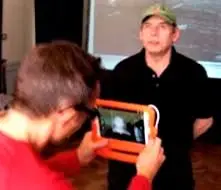
He demonstrated the 3D imaging technique he would be using in Spalding. With a device no larger than a school atlas waved along the people in the front row he produced an image on the screen behind something like a Leonardo da Vinci drawing.
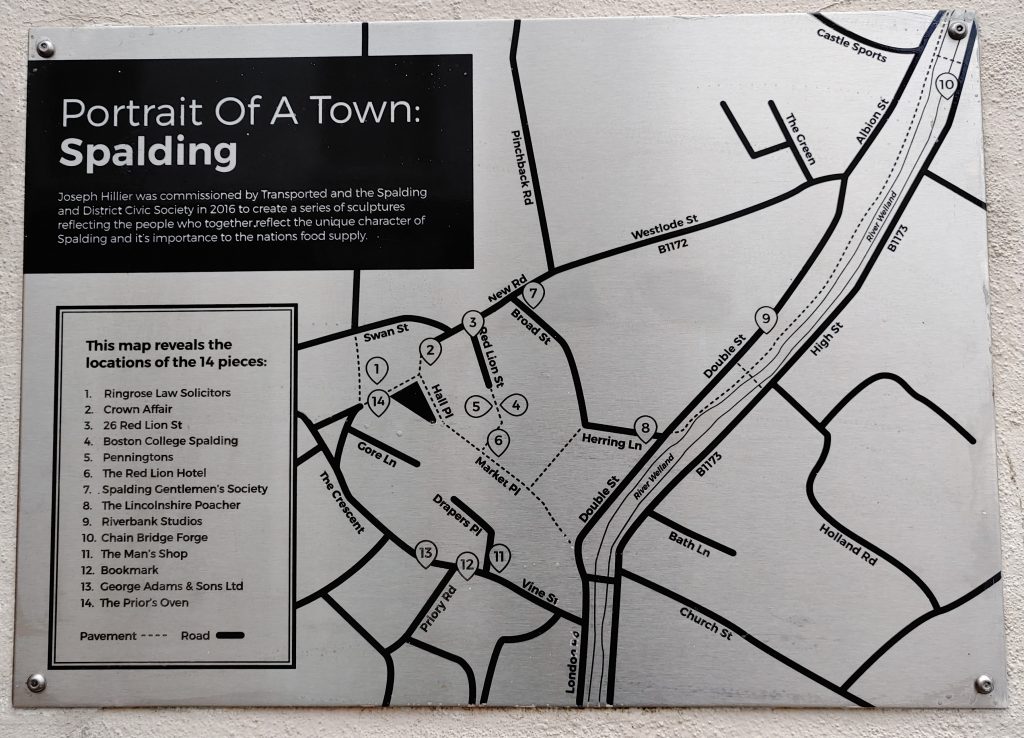
His work for Spalding is inspired by the annual Statute or Hiring Fair which was held in Hall Place every May. Rather than a large single figure, the work takes the form of over a dozen wall-mounted small bronze reliefs clustered round Hall Place and fanning out into the Pied Calf Yard, Red Lion Street, the Hole-in-the-Wall Passage, and so on. A visitor might come upon one unexpectedly or could more methodically follow a trail.
An open invitation via the local press and on-line for models to be immortalised in bronze produced an interesting succession of people on 25 and 26 September 2015: an evacuee from WW2 who stayed, a drainage engineer, an elderly village postmaster and his wife, a schoolgirl, a gardener whose father and uncles were farmers, a local councillor, a market trader ……
Each of them was first coaxed to talk about their lives and memories of South Holland (prompted by archive photographs, for example). “My father, I remember, owned a reaper-and-binder, which threw out sheaves at the back, and these …,” lacing his fingers into an A-shape, “were stooked across the field to dry.” Joseph was listening for the words that for a variety of poses for the bronzes.
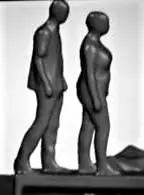
Then he would circle crabwise round the model with the imaging device. The father and son hanging from a ledge by their finger-tips, the young couple crossing a bridge (right: the resulting 3D image), a blacksmith with raised sledge-hammer, and so on. “Where in Spalding do you and your friends normally hang out?” to the schoolgirl. “Well, we go to the Candy Bar, then Bookmark, and then sometimes sit on a wall with chips.” “So what about sitting on the edge of the table there?” Pause. “I don’t want to be immortalised eating chips.”
After people had posed for Joseph Hillier’s 3D imaging camera the images were captured inside his computer. Here each image could be turned this way and that in search of the most effective angle and be manipulated in all sorts of other ways too: the background eliminated, for example, the rear of the figure shaved flat if it was eventually to be mounted on a wall, or a limb adjusted slightly to fuse it with a prop so that the final figure would be less vulnerable.
The faces of course remained untouched. These are local people: the young blacksmith, the drainage engineer, the farmer and author, the market trader.
By now the figure was beginning to look statue-like , but it was still only an electronic image.The figures have no physical actuality. That was the next stage, when the electronic image was fed into a 3D printer and, layer by plastic layer, a solid physical object built up. It was these plastic models, given a coating of graphite dust to make them look like metal, that we saw at the end of January 2016.
Once planning applications for their sites in the town centre had been submitted and approved the little figures were cast in bronze and were unveiled on 22 April 2016.
Time has seen the bronze mature and many people have since walked past without noticing them but some may just catch sight of one of the fourteen that are to be found around the town out of the corner of the eye.
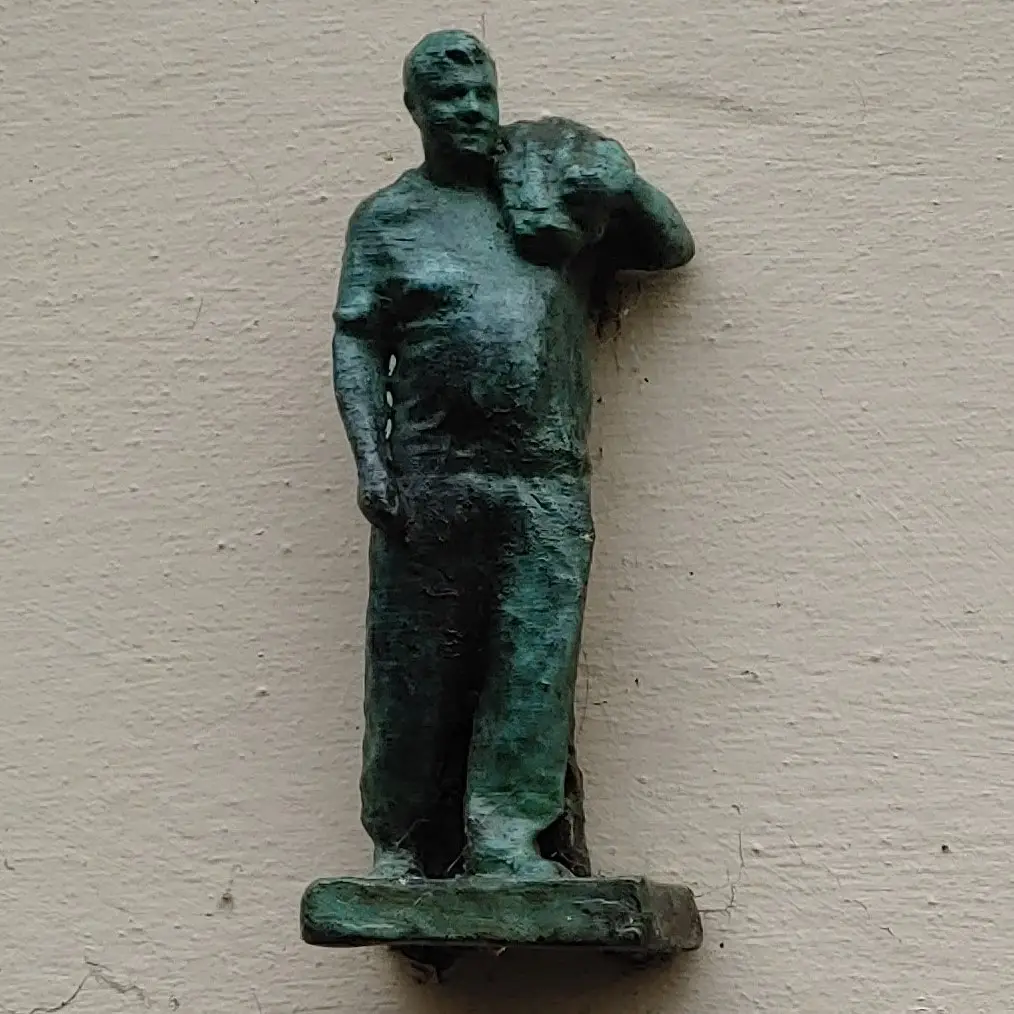
Where they are. Who they are.
Town Centre
Calthrops, 18 Hall Place ///ozone.brass.manliness – Ian Tyers (auction clerk).
An auction clerk in a vegetable market in Spalding works, like a scribe, at a purpose made table. The role of the auction and this town is pivotal in this rural economy where the produce of the land and the people who work it is vital.
The Beauty Room, 24 Hall Place ///later.whites.mirror – Mick Lawson (grower).
This grower has just made his weekly delivery to auction. Many local farmers with smaller holdings bring a couple of pallets of their produce to this auction by tractor before 8 am.
26 Red Lion Street ///debit.rods.whites , next to Pacey’s – Pauline Pindara (produce packager).
Working on a large-scale farm, labelling shrink-wrapped broccoli, ready for supermarket shelves, this high-tech scene resembles the potato riddling that went on in Lincolnshire for generations.
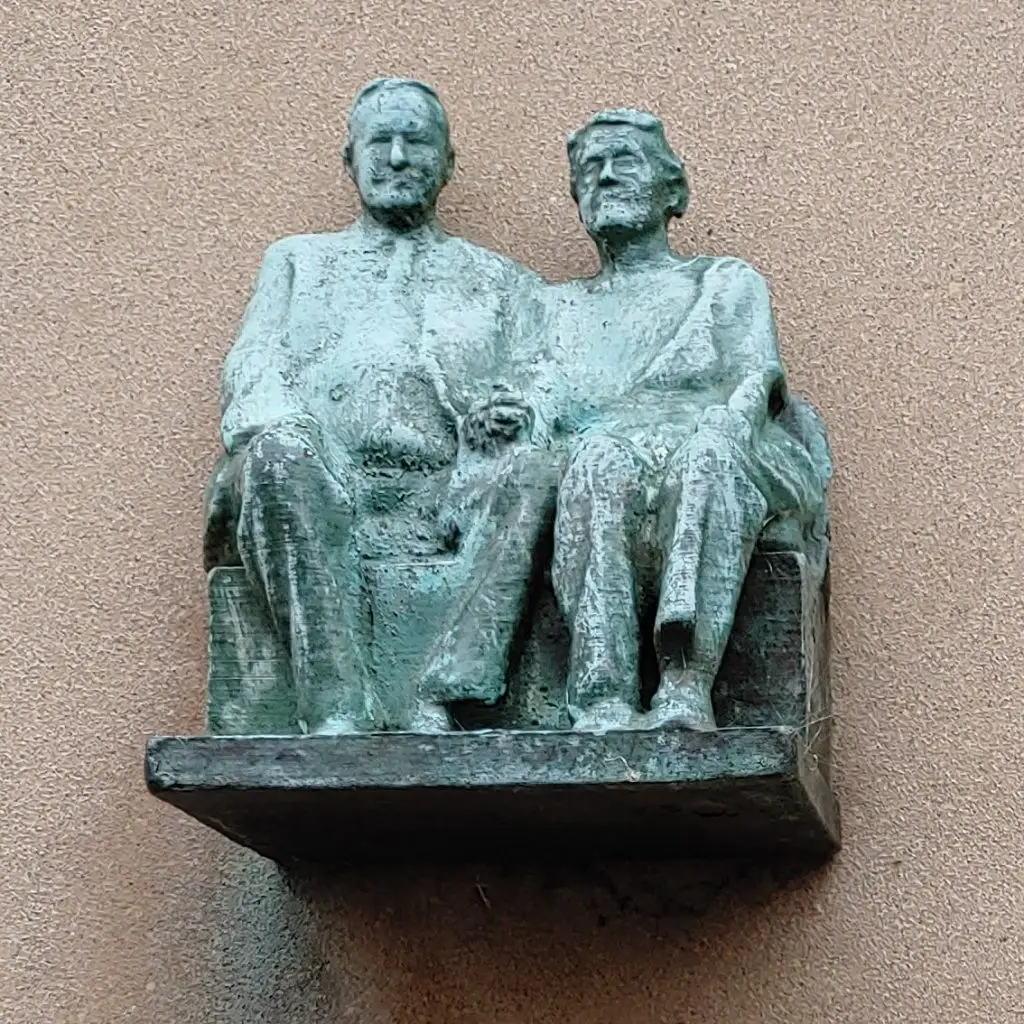
Boston College, Red Lion Street ///solar.accent.moment– Peter and Vivian Higham (postmaster and post-mistress at Cowbit).
This portrait of the former postmaster and mistress of Cowbit, was an attempt to replace their lost wedding photographs. Their close interdependence is evident in their tightly interlocked fingers.
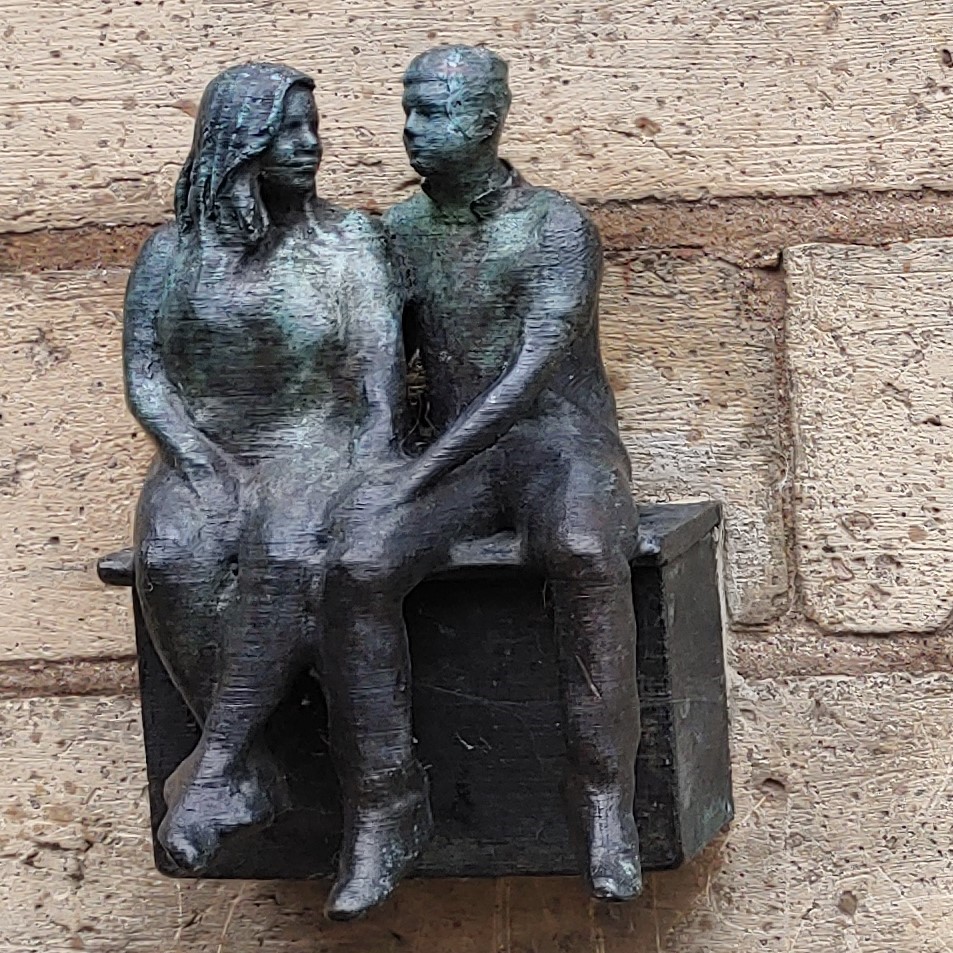
Pennington’s, 2-3 Red Lion Street ///spell.costs.vine – Kristina Taylor and Sam Morgan
Kristina was expecting her first child when this portrait was taken (the baby arrived before the sculpture). The pair sat with their legs swinging in the carefree yet expectant moments before embarking on a life together.
Red Lion Hotel, Market Place ///votes.sweat.energy – Steven Andrews (market trader).
Market trader and a master of banter, Steven’s market stall is often situated near The Red Lion on a Tuesday.
Spalding Gentlemen’s Society, 9 Broad Street ///brass.upset.tower – Maia Dempsey (student)
This quietly assured student was asked to do something she would normally in town. By preserving this familiar contemporary image in bronze it will become a curiosity as technology develops.
Wildvine, The Crescent ///assist.engage.peanut– Bartosz Maslowski (farm onion packer)
Bartosz was working in a warehouse with 20 or so other young people.The intensive arable production of Lincolnshire demands much physical human work. This is the constant story of Lincolnshire
Former Bookmark, 18-20 The Crescent ///scars.quiz.hype – Rex Sly (farmer and writer)
Rex farms, thinks and writes. His first book was sold in this bookshop and his portrait has been made with his book, Soil in Their Souls.
Geo. Adams & Sons, 25-26 The Crescent ///priced.adjust.crib – Mary and Elizabeth Adams (directors of long-established family butcher’s).
Two sisters, and granddaughters to the original owner, now run this butchers shop on The Crescent. It may soon be time to update the sign.
Prior’s Oven, 2 Sheepmarket ///snacks.fortunate.ranks – Fiona and Carol Grundy (farmers, including prize sheep).
This mother and daughter keep prize sheep. Their connection to livestock is reflected through the choice of location, the entrance to Spalding’s old Sheep Market.
Riverside
Lincolnshire Poacher, Herring Lane ///agreed.piper.foods – John Honnor (drainage engineer).
This drainage engineer has kept his analogue tools, which have enabled the water from the west to return to the sea. A portrait of Spalding would be incomplete without remembering the salient fact that this land is reclaimed by human ingenuity and work, from the sea.
Riverbank Studios, Riverside Walk ///fuel.galaxy.cattle (northwards just past Holland Road foot-bridge) – John Gray and Helen Webber (artists).
These two artists run a painting studio in Spalding. They collaborated to create this mountain from a few props and blankets to serve as a metaphor for the gifts they bring as artists to this fertile flat land.
Chain Bridge Forge, High Street ///organ.rots.slim (over the next footbridge) – Will Pegram (black-smith)
The blacksmith from this local museum posed in response to a photograph from Ayscoughfee Museum of another blacksmith approximately 100 years ago. Like that early photograph this work is the result of a staged and stationary pose, using the current equivalent of those early photography techniques: digital 3D scanning.
A digital map of the trail has been produced by Heritage South Holland which can be found here.