
Background
One of the key events that was to lead to the formation of Spalding & District Civic Society was the loss of Holyrood House a few years earlier. Holyrood House – like Ayscoughfee Hall next door – was a late mediaeval mansion. Its front and interior were given a handsome makeover in Georgian times, and it was the home of Johnson family members for many years. It was bought by Spalding Urban District Council in 1954 with the intention of knocking it down to build a town hall for themselves.
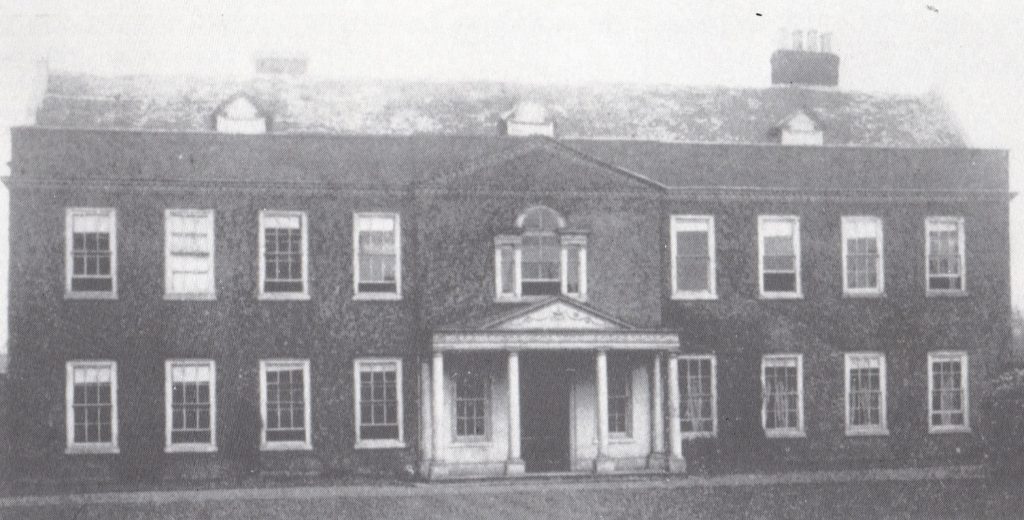
This provoked a wide spread outcry which included included the voice of John Betjeman:-
Holyrood House, Spalding. A charming late Georgian building in a town fast destroying its beauty. The town of Spalding is the demolisher. Is not the Spalding Gentlemen’s Society one of our oldest polite institutions? And, ought it not to be defending this building?
John Betjeman, The Spectator, December 1954
It was Stanley Wyndham Woodward, librarian of Spalding Gentlemen’s Society and headmaster at Spalding Grammar School, who noted Betjeman’s words and encouraged Spalding Gentlemen’s Society to act, and a campaign began. In June 1956, following a deputation from the Gentlemen’s Society, the Ministry of Housing and Local Government placed a preservation order on Holyrood House “in view of the undoubted merit of the building.” A “prize piece of ministerial meddling,” fumed the local press. “Ah,” purred the Clerk to the Council to the elected members, “you cannot pull it down, [but] they cannot compel you to repair it.” (Spalding Guardian, 8 June 1956). And so it was. They didn’t. And the rains came and found out the places that were weak and the mortar crumbled and the timbers began to rot……
The town hall that replaced it is now the Social Services Offices.
It was this disgraceful disregard for our heritage that led to our formation. “Never again,” was the determination.
The Civic Movement
In July 1957, former Housing Minister, Duncan Sandys, who had been convinced that voluntary associations must play a part in shaping towns and cities, established the Civic Trust. This was an an independent, non-profit-making organisation which sought to promote high standards of architecture and civic planning and to encourage a wider interest in the appearance of towns, villages and countryside. The Civic Trust brought together existing Civic Societies, such as Wisbech Society and Preservation Trust (established in 1939), and supported the formation of new Societies including those in Grantham, Boston, Stamford and Peterborough.
They enabled groups of private citizens to co-operate with local government, industry and commerce in the preservation and improvement of the appearance of their town and district.
The Civic Movement in Great Britain can be traced back for over a century. Read our brief history of the Movement in England adapted from the Brief History of the Civic Society Movement by Lucy E Hewitt published by Civic Voice in 2014 below.

Formation of our Society
The idea for a Civic Society in Spalding was first suggested by Stanley Woodward who a few years before had played a key role in efforts to try and save Holyrood House.
The Earl of Ancaster, Lord Lieutenant of Lincolnshire, backed the idea and an exploratory meeting was held at Spalding Grammar School on 16 December 1960. This was attended by Headteachers, local government officers, traders, a doctor and other members of the public, including three schoolboys. A presentation was given by Mr. Michael Dower, of the headquarters of the Civic Trust, who gave a talk and also showed a film of the work that had been carried out in other towns, including the example of a scheme in Magdalen Street in Norwich, which in 1959 had been given a “face-lift,” and had since attracted more and more shoppers to the street and the town. The film survives and can be seen in the East Anglian Film Archive.
It was Mr. Dower’s first visit to Spalding, and he described the town as “clearly a place of great attraction and also of great possibilities for further development.”
Those present agreed to support the formation of a Civic Society in Spalding, and a holding committee was formed consisting of Captain E. J. S. Maples (chairman), Mr. C. F. Ford, Mr. D. Frost, Mr. K. Smith, Mr. R. Stanley, Mr. S. W. Woodward and Mrs. Woodward (secretary).
The first Annual General Meeting of the Society was held in Spalding Grammar School library on 22 February 1961. It was attended by many prominent townspeople including local government officers, schoolteachers, solicitors, traders, businessmen and a doctor. Also present was the Earl of Ancaster, who accepted an invitation to become the Society’s first President, and John Mowat, a member of the Peterborough Civic Society committee founded nine years previously.
Aims
Achievements
The Society has done more for Spalding than many will be aware of, particularly as the years have passed, but also down to the long time it can take to get things done. Whilst not an exhaustive list, some of the major achievements include:-
- In 1963, together with Spalding Urban District Council, we encouraged and supported traders in The Crescent, to beautify the street along similar lines to scheme carried out on Magdalen Street, Norwich.
- In 1965 at our suggestion, a scheme to beautify Riverside Walk from Herring Lane to Chain Bridge was underway. This included the installation of benches by the Society, and a pathway dug by Gleed School pupils, and the planting of bulbs by local schoolchildren which were donated by the South Holland Growers Club. Bushes and shrubs were also planted close to buildings on the riverbank, donated by a local grower.
- In 1966, we prevented a “John Adams Way” type of inner relief road that would have run from High Bridge to Pinchbeck Road and went on to secure agreement from the Government Minister to build a by-pass.
- In 1967 we secured a pledge from Spalding Urban District Council to build a new indoor swimming pool. This was opened in 1973, just before the Urban District Council was replaced by South Holland District Council.
- In 1972 with the support of Holland County Council, we planted 30 trees in Halmergate.
- In 1976 with the support of South Holland District Council, we planted beech and oak trees on a quarter mile stretch of the banks of Coronation Channel together with over 200kg of daffodil bulbs.
- In 1978 with the support of Lincolnshire County Council we planted 150 trees, in the field opposite the entrance to Springfields Gardens. Some of these trees survive along the bank of Coronation Channel.
- In 1986, we revealed plans to restore riverside wharfs along a 300 metre stretch of the riverbank along High Street. The £50,000 scheme was commended by judges in the “Pride of Place” competition run by the Civic Trust. The restoration work was carried out during 1987 and 1988 and was supported by the Manpower Services Commission, Richard Branson’s UK2000 partnership and Turners Turkeys. The project provided employment and training for 18 long term unemployed people via the Community Task Force.
- In 1990 we successfully halted a proposal by British Rail to demolish the original Victorian Spalding Railway Station buildings.
- In 1991 with the support of South Holland District Council and Lincolnshire County Council, we planted 250 trees along Cradge Bank.
- In 1992 with the support of South Holland District Council we planted trees in Ayscoughfee Gardens and along the West Elloe Bridge end of the Riverbank.
- In 1993 we organised a tidy-up and planting of wild flowers on the site of the old Savoy Cinema on London Road.
- In 1993 in partnership with South Holland District Council, Lincolnshire County Council, the National Rivers Authority, the Community Task Force & local businesses, we supported long term unemployed to create a cycleway between Holland Road footbridge and West Elloe bridge. The scheme included the planting of shrubs along Commercial Road, and Albion Street and the planting of more bulbs.
- In 1994 we planted 900 wild plants on the banks of the River Welland & Coronation Channel.
- In 2009 we conceived the idea of the Market Art Project (now MARK-IT) to mark the sites of Spalding’s historic markets by a series of public realm art works.
- Between 2011 and 2015 we intervened to protect Chiltern Drive and Severn Road Playing Fields from unwanted development. We also supported action to ensure that the Sir Halley Stewart Playing Field remained available as a playing field for all residents of the town to use in accordance with the terms of the Trust Deed.
- In 2012, we launched our Blue Plaque scheme.
- in 2016, we unveiled the first of our art installations in our MARK-IT Trail, the Portrait of a Town Trail.
- In 2016, we launched our campaign against the blanking-out of shop windows, which eventually resulted in the production of the Spalding Shop Front Design Guide in 2025.
- In 2019, the second commission in the MARK-IT Trail, The Hiring statue was unveiled.
- In 2025 we unveiled two of our MARK-IT Trail commissions; sculptures of sheep in the Sheepmarket and cattle in New Road.
Members drive what we do
As can be seen above, the Society has undertaken a wide range of projects and improvements that have made a positive contribution to the town. There have of course been other activities over the years, whether it be keeping a watching brief on planning applications, or organising tidy-ups in the town, arranging talks and walks, or undertaking historical research. Whilst we do not have a monopoly on delivering positive change for the town and welcome the efforts of others, we hope that the above might inspire you to join us, and play your part in our aims of caring for and improving the town of Spalding and the surrounding district.
We are a registered charity and as such have a structure that enables us to apply for grants to undertake improvements in the town. Our income comes from member subscriptions, donations and grants for specific projects. If there is something you would like us to do in the town, then join us. Together, we can make a difference.
Membership is open to individuals and also organisations (contact us for details).