Miss Charinton's Churches
Although Charlotte Charinton lived a modest and frugal life on London Road, her outstanding generosity in the building and restoration of local churches meant she was known well beyond South Holland. The Yorkshire Post and Leeds Intelligencer of 10 January 1888, for example, recorded her death, with an account of the churches that had benefited from her munificence.
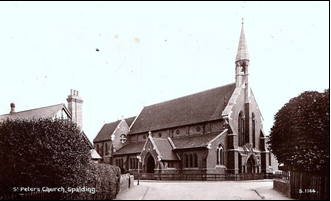
Built 1875-6, where Priory Road bends round towards the Crescent. (Chancel funded by Miss Charinton.) To the south was the Spalding Collegiate School for Young Ladies & Kindergarten, and five years later the newly built Johnson Hospital would open directly opposite. Demolished 1968 – to provide a car park for the Spalding Rural District Council offices behind. When South Holland District Council was created in the local government reorganisation of 1974, the new council built its offices on the RDC’s carpark, and its own car park by clearing the site of the former Young Ladies’ School, later the Avalon Wards adjunct to the Hospital.
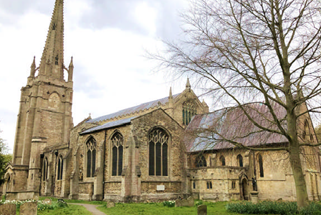
A wide and varied building of the 13th century and later. Restored 1865-7.
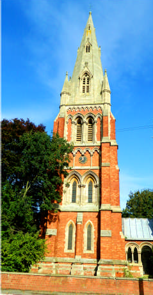
Site, church, vicarage and school funded entirely by Miss Charinton, together with an endowment of £300 a year. She laid the foundation stone in 1877 (and was presented with a silver trowel) and the church opened in 1881. She also donated the church’s eight bells.
A detailed survey and analysis of this church designed by renowned architect Sir George Gilbert Scott whose work included St Pancras Station in was produced by Historic England 2008.
Rebuilt in the 14th century and restored three times in the 19th. The stonework of the roof of the north porch is described by Pevsner as “delightfully lacy”, but of the two “not at all ecclesi- astical-looking” round towers that flank it, “nothing seems to be known”, he says.
A 14th century church with an “exciting and unusual interior” (Pevsner), the nave arcades being supported on “massive octagonal wooden posts”. Only three or four like it in England. Struck by lightning in 1872. The major work required provided an opportunity for restoration (1875). Miss Charinton further donated a carved pulpit in memory of her father. Church now on the Historic England’s Heritage at Risk register – condition ‘poor’
Early 15th century. 1882 restoration mainly financed by Miss Charinton.
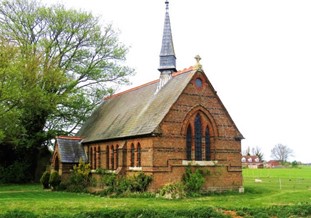
An acre of land donated for the building of this mission chapel.