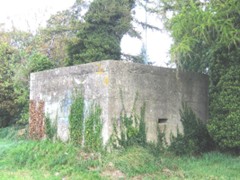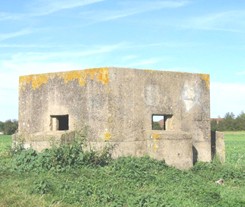
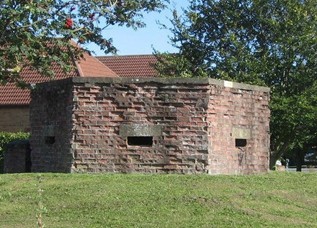
Probably the last thing an MP would expect in the post is a letter from a constituent about a WW2 pillbox. Yet that is what Sir John Hayes received in 2019. Did he know anything about the one in Monkshouse Lane and was it ‘listed’ and what might be done to preserve it? Sir John passed the enquiry on to the Society and also to “a local history enthusiast”.
Knowing only that there were two other Spalding pillboxes, all ‘unlisted’, with a fourth (at the Woolram Wygate railway crossing) demolished in 2001, we passed the enquiry on to Ian Marshman (LCC Historic Environment Officer); and also to the Gentlemen’s Society.
Entries Ian sent from the LCC Historic Environ-ment Record state briefly the location, form and construction of the three ‘boxes. Two (in Buttercup Close and off Horseshoe Bridge Road) are built to a standard hexagonal War Office pattern (Type 22), the first in brick, the second in concrete, while the Monkshouse Lane ‘box (square, concrete) conforms to no War Office pattern at all. A map shows the three of them are in a dead straight line.
Meanwhile, the local history enthusiast (Peter Darley) had just about given up a fruitless search when he came across Defending Lincolnshire by Dr.Mike Osborne, with whom he got in informative touch. (Dr.Osborne has also written the slim Lincolnshire volume in the 20th Century Defence in Britain series, copy in the Spalding Library.) Putting Dr.Osborne’s material together, the following overall picture emerges.
“The entire Lincolnshire coast was regarded as a potential landing beach,” and after Dunkirk “The coast was fortified with the intention of delaying an invading force for as long as possible.” The Monkshouse Lane pillbox “stood to protect a nodal point – the main road to Bourne”. Built of timber surrounded by concrete 36 inches thick, it would have been “a formidable defence”. Several suggestions for its unorthodox design (“a DIY job”), include its being put up by local builders working to the drawings of “retired military men”, as it resembles German structures on the Western Front in
the Great War. In addition to the pillbox there would have been a road-block and barbed wire; and it would have been manned by the Home Guard.
Ian Marshman thinks the three ‘boxes were part of a defence network round Spalding, protecting the “wide open area between Vernatt’s Drain and the Welland”, not “a stop-line to halt an invasion force”, as – despite the ‘boxes’ cross-country line – stop-lines “usually utilise features like drains and rivers”.
By now, committee member Robert West had located floor-plans (Heritage Lincolnshire) and come across the cautionary tale below. The upshot is that Sir John has asked for all three pillboxes to be put on the SHDC Heritage Register.
Remarkable what a flurry of activity can result from a single letter. Many thanks to all involved, and any further information about Spalding’s pillboxes would be most welcome – and passed on.□
ELSEWHERE in the county two pillboxes which had been put up to guard a narrow grass track inland from the lonely coastline were now just hindrances in the middle of a large field created post-war from earlier smaller ones. Following failure to demolish them with a JCB bucket, “The only thing to do was to move them intact,” said the farmer. So each pillbox was tipped over onto one of its eight sides and “rolled to the edge of the field”, where they now sit side by side “tucked away behind a house in the shade of a hedge”, guarding ……… what? A real puzzle for future local historians. (Abbreviated from Lincolnshire Past and Present, Autumn 1992.)