MARK-IT:Market Heritage
Spalding (Spallinge) was recordedin the Domesday Book (1086) as having a Market with a yearly value of forty shillings. It was one of five Lincolnshire towns recorded to have a market, and one of just fifty in England.
In medieval England, the central role of a market town was to facilitate the exchange of agricultural produce for simple goods – such as cloth, cooking pots, pottery, shoes, tools, wooden products–made by the craftsmen and artisans of the town. The award of a market charter by King Henry III on 6 May 1242, long before Stamford and Boston, reflects the historical importance of Spalding as a market town.
It is known that by 1336 that livestock such as oxen and horses were being traded in Spalding along with corn, malt, cattle hides, meat, cloth, wine, honey, wool, salt, dairy products and fish.
Livestock in the Fens
The area around Spalding was very different from now. Before the introduction of the steam engine enabling the fens of South Holland to be reliably drained, much of the land in summer was used for grazing of cattle and sheep and an array of other livestock.
Hemp and flax are grown in the neighbourhood; but of late years the growth has very much decreased; however, what is grown is brought to the market and fairs; the market has been for many years, and still continues to be, one of the best in the Kingdom for fat stock; it is holden on Tuesday; fairs, April 27, for hemp and flax, horned cattle, sheep &c. June 29, for ditto and horses; August 28, for horses, September 25, for hemp and flax, horned cattle, sheep and town fair; December 6, for hemp and flax, horned cattle, sheep and town fair.
Source: The Universal British Directory of Trade, Commerce, and Manufacture 1790-1798
“I walked on from Holbeach, six miles, towards Boston; and seeing the fatness of the land, and the fine grass and the never-ending sheep lying about like fat hogs, stretched in the sun…”
William Cobbett
Anti-Corn Law Campaigner
Rural Rides 1830
“It is impossible to speak too highly in praise of the cottage system of Lincolnshire, where land, gardens, cows, and pigs are so general in the hands of the poor. Upon views only of humanity and benevolence, it is gratifying to every honest heart to see that class of people comfortable, upon which all others depend”
“All round Spalding, there are many good bullocks grazed, and in Deeping Fen also”
Arthur Young
Secretary of the Board of Agriculture and Internal Improvement
1813
Source: General View of the Agriculture of Lincolnshire
Source: Project Gutenberg
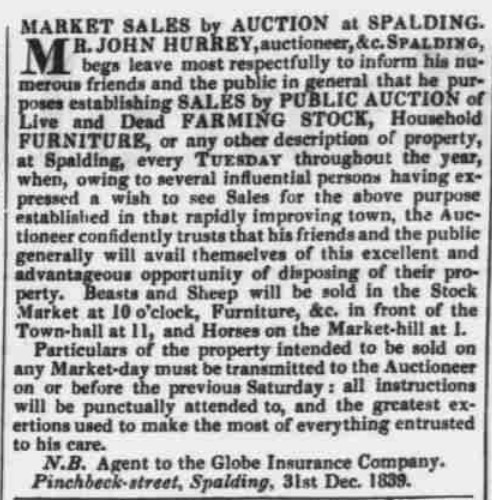
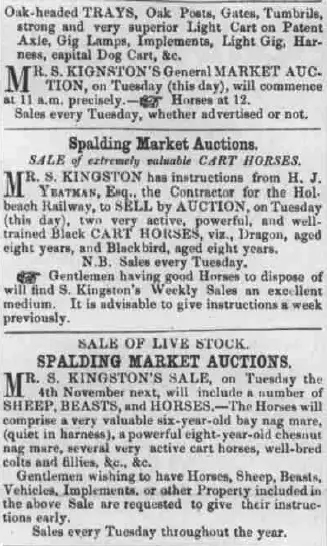
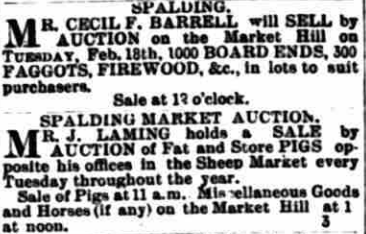
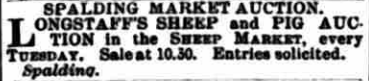
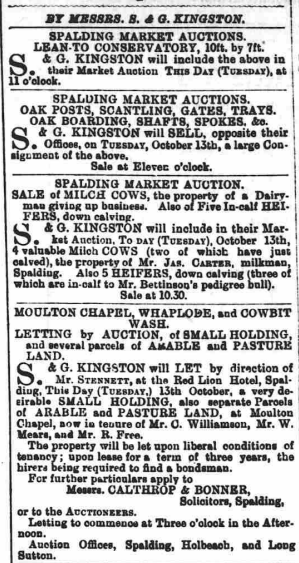
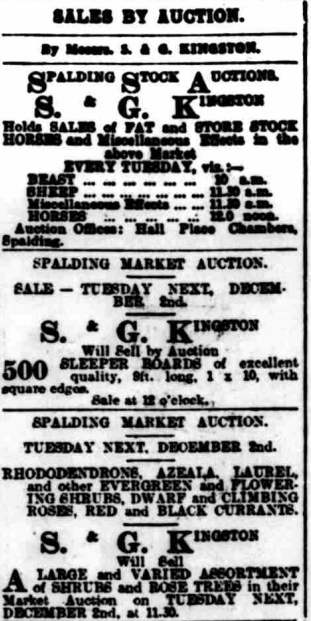
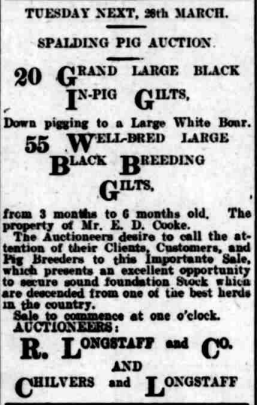
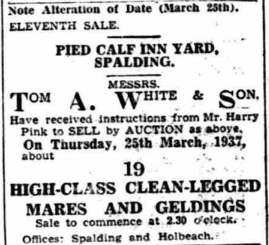
Newspaper advertising
By the C19th local auctioneers were advertising their regular auctions in the local press. Some of the businesses still exist in the town today.
Some examples below. Click on the image below to see the full advert
Fairs
There were also five larger annual fairs and two hiring fairs that enabled the many agricultural labourers to secure work for the months ahead.
Find out more about the Hiring Fair below.
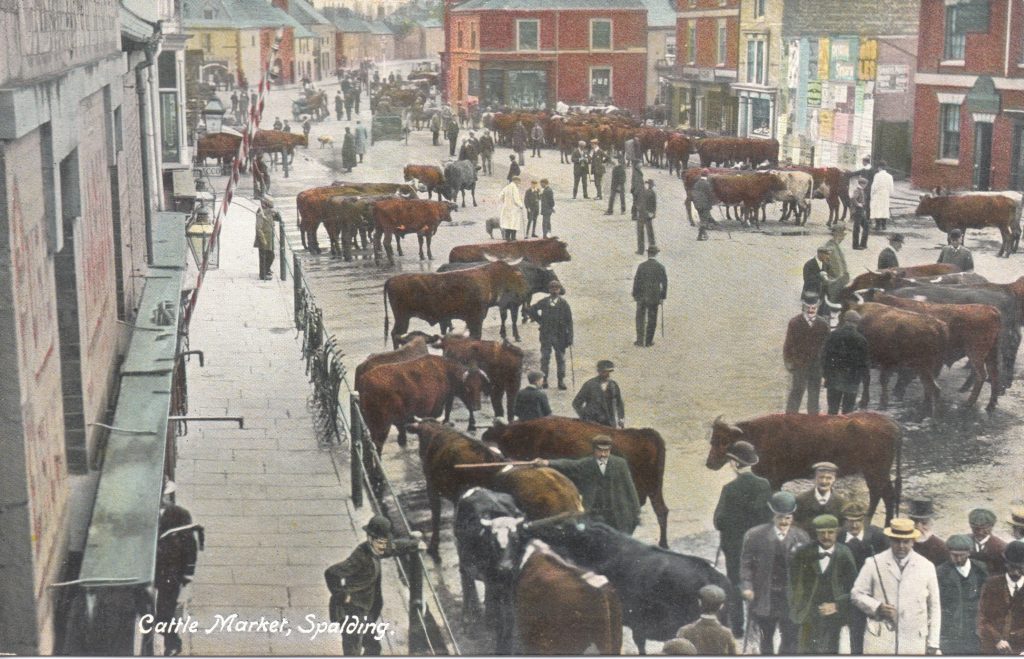
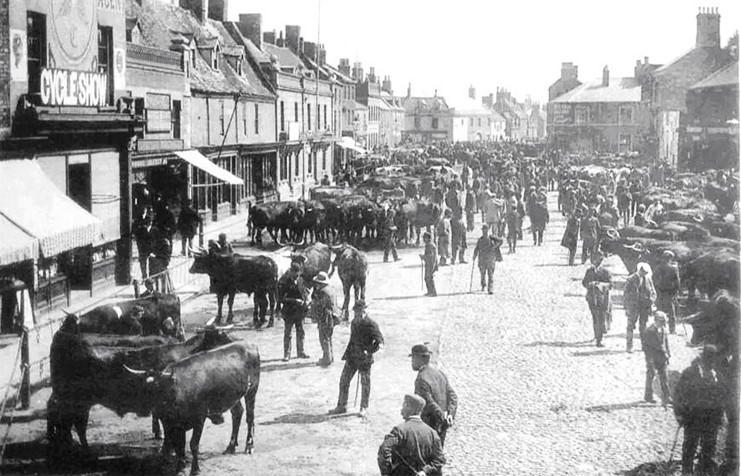
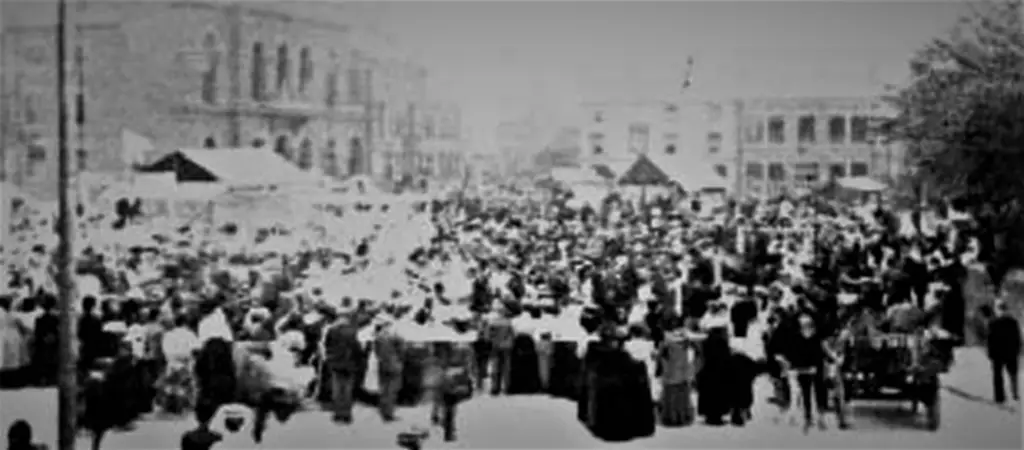
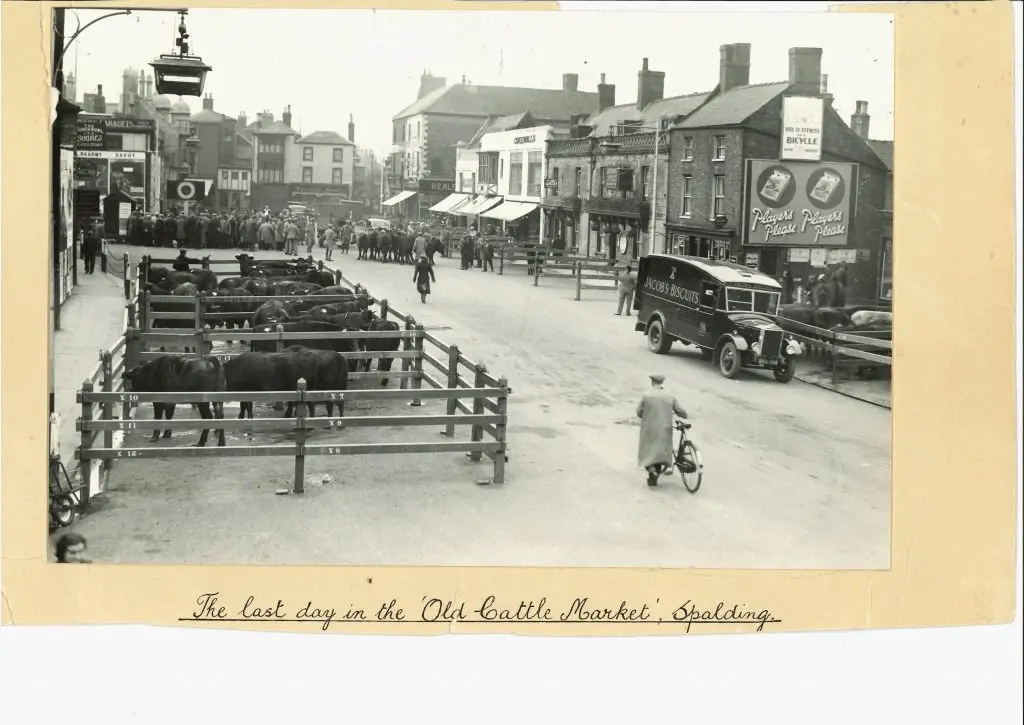
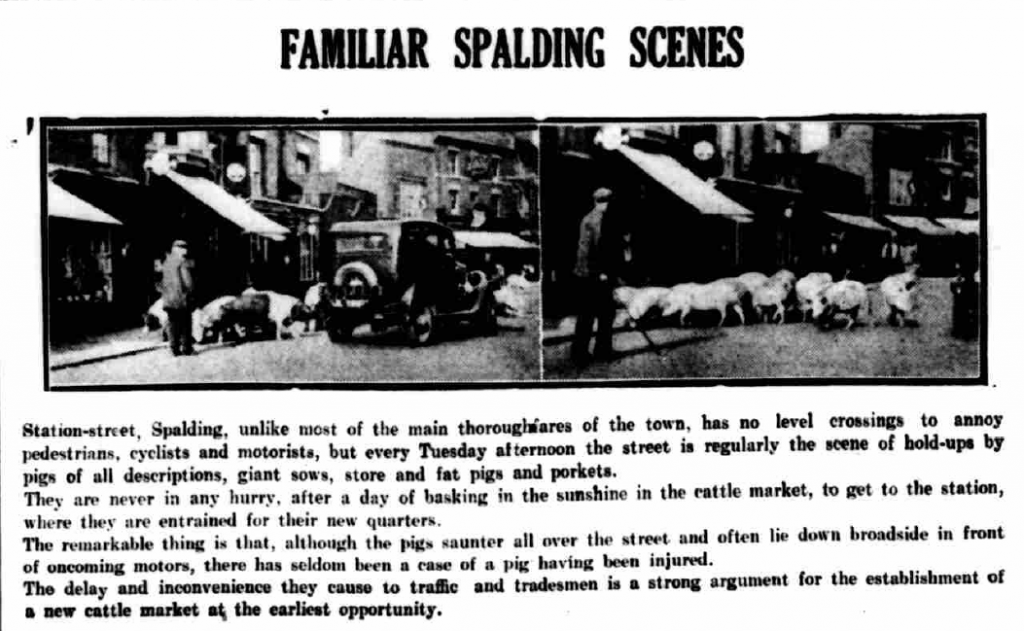
Spalding’s markets were held on the streets of the town. Sheep and poultry were sold in Sheep Market, Cattle and Horses on New Road, Pigs on Red Lion Street, Dairy Produce at the Buttermarket.
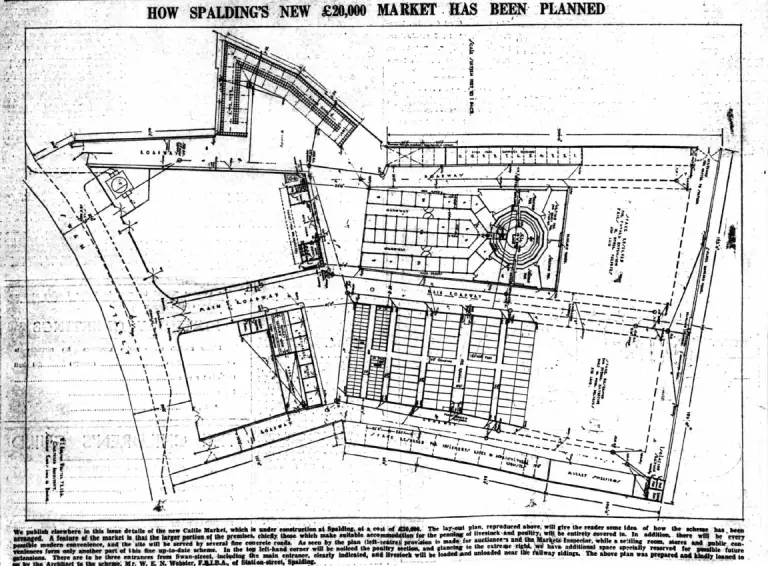
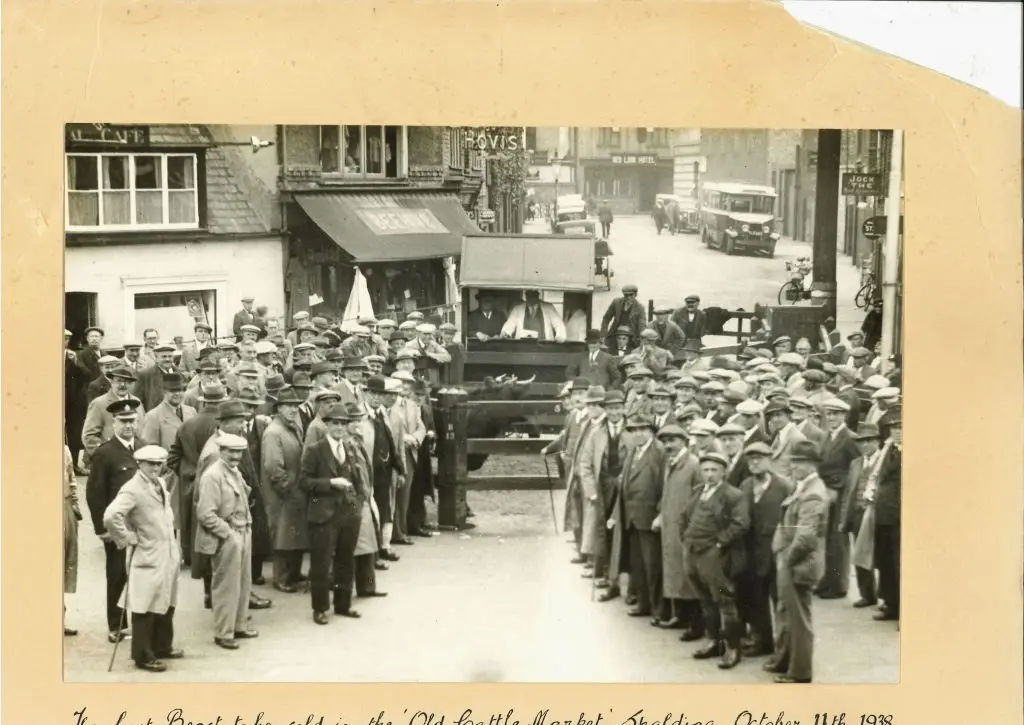
There was hardly any part of the town centre where goods and produce were not being traded on market day. What makes the story of Spalding’s livestock markets so different from many other towns is the long time it took to decide to build a purpose-built cattle market. The idea of a purpose-built cattle market was mooted in 1873 and again in 1912 when a proposal for a market of Westlode Street was proposed, but it wasn’t until the 1930s that plans were drawn up to build a new cattle market on New Road that is now occupied by Holland Market.
Eventually the new market was built and the tradition of livestock auctions on the streets of Spalding came to an end on 11th October 1938.
The new market was officially opened on Friday 14th October 1938 by Sir John Chancellor, the Chairman of the Livestock Commission.
At the ceremony, the Chairman of Spalding Urban District Council, Councillor C A Banks remarked:-
“Those of us who were in Spalding last Tuesday almost felt that we were present at the funeral of a very old acquaintance from whom we parted with somewhat mixed feeling. It is hard to believe that never again will a lady passing along New-road, some Tuesday, complain that by some means , over which she had no control the pattern of her summer frock has been suddenly varied and her favourite scent, for the time being, overwhelmed. (Loud laughter). “Nor, I suppose, is the Council likely to be faced again with the problem as to whether a shopkeeper, who has unwillingly entertained a beast in premises near the old cattle market, should or should not be awarded compensation.
Whilst there must be some regret at the breaking of a very ancient custom, all progressively minded people will agree that the new market is long overdue. It has been interesting to remember that it has been under consideration for more than 70 years, so the present council cannot be accused of acting with undue haste! We almost made a beginning about 10 years ago, but a majority of the Council took refuge in the over-worked phrase, ‘The time is not opportune,’ and we now carried out the scheme at an increased cost.”
As farming practices changed, with less livestock being kept in the area, usage of the livestock market fell, and it finally closed its doors in 1992 and the centuries old tradition of farm animals being brought and sold at auctions in the town is now fading into distant memory.
We have gathered some memories of the livestock markets. Can you add to them?